Which Is the Center Key in an Old Fashioned Typewriter
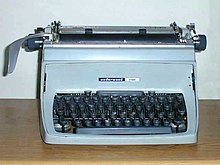
Mechanical desktop typewriters, such as this Touchmaster Five, were long-fourth dimension standards of government agencies, newsrooms and offices
Video showing the operation of a typewriter

Disassembled parts of an Adler Favorit mechanical typewriter
A typewriter is a mechanical or electromechanical machine for typing characters. Typically, a typewriter has an array of keys, and each one causes a different single character to exist produced on paper by hit an inked ribbon selectively against the paper with a type element. At the finish of the nineteenth century, the term 'typewriter' was also practical to a person who used such a device.[ane]
The commencement commercial typewriters were introduced in 1874,[ii] merely did non get mutual in offices until after the mid-1880s.[3] [ where? ] The typewriter quickly became an indispensable tool for practically all writing other than personal handwritten correspondence. It was widely used by professional person writers, in offices, business correspondence in private homes, and by students preparing written assignments.
Typewriters were a standard fixture in most offices up to the 1980s. Thereafter, they began to exist largely supplanted by personal computers running give-and-take processing software. Yet, typewriters remain common in some parts of the world. In many Indian cities and towns, for instance, typewriters are still used, especially in roadside and legal offices due to a lack of continuous, reliable electricity.[iv] The QWERTY keyboard layout, developed for typewriters in the 1870s, remains the standard for computer keyboards, although the origins of this layout remain in dispute, whether information technology was developed for mechanical reasons or to accommodate the operator, particularly Morse lawmaking operators [5]
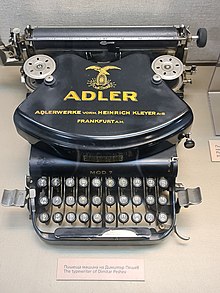
Notable typewriter manufacturers included E. Remington and Sons, IBM, Godrej,[6] Imperial Typewriter Company, Oliver Typewriter Company, Olivetti, Royal Typewriter Visitor, Smith Corona, Underwood Typewriter Company, Adler Typewriter Company and Olympia-Werke.[7]
History [edit]

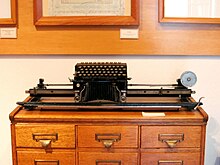
Peter Mitterhofer's typewriter epitome (1864)
Although many modernistic typewriters have one of several like designs, their invention was incremental, developed past numerous inventors working independently or in competition with each other over a serial of decades. As with the car, telephone, and telegraph, a number of people contributed insights and inventions that eventually resulted in ever more than commercially successful instruments. Historians take estimated that some form of typewriter was invented 52 times every bit thinkers tried to come up upwardly with a workable design.[8]
Some early typing instruments include:
- In 1575, an Italian printmaker, Francesco Rampazetto, invented the scrittura tattile , a machine to impress letters in papers.[9]
- In 1714, Henry Mill obtained a patent in Britain for a machine that, from the patent, appears to have been similar to a typewriter. The patent shows that this car was actually created: "[he] hath by his smashing study and paines & expence invented and brought to perfection an artificial machine or method for impressing or transcribing of letters, ane after another, as in writing, whereby all writing whatsoever may exist engrossed in newspaper or parchment and so groovy and verbal every bit not to be distinguished from impress; that the said auto or method may be of great use in settlements and public records, the impression being deeper and more lasting than whatsoever other writing, and not to be erased or counterfeited without manifest discovery."[ten]
- In 1802, Italian Agostino Fantoni adult a item typewriter to enable his blind sister to write.[xi]
- Between 1801 and 1808, Italian Pellegrino Turri invented a typewriter for his blind friend Countess Carolina Fantoni da Fivizzano.[12]
- In 1823, Italian Pietro Conti da Cilavegna invented a new model of typewriter, the tachigrafo , also known equally tachitipo .[13]
- In 1829, American William Austin Burt patented a machine called the "Typographer" which, in common with many other early machines, is listed as the "first typewriter". The London Scientific discipline Museum describes it merely as "the showtime writing mechanism whose invention was documented", just even that claim may be excessive, since Turri's invention pre-dates it.[14]
By the mid-19th century, the increasing pace of business communication had created a demand for mechanization of the writing process. Stenographers and telegraphers could have downwards data at rates upward to 130 words per infinitesimal, whereas a author with a pen was express to a maximum of 30 words per minute (the 1853 speed record).[fifteen]
- American Charles Thurber developed multiple patents, of which his first in 1843 was adult as an assistance to the blind, such equally the 1845 Chirographer.[16]
- In 1855, the Italian Giuseppe Ravizza created a image typewriter called Cembalo scrivano o macchina da scrivere a tasti ("Scribe harpsichord, or machine for writing with keys"). '
- In 1861, Father Francisco João de Azevedo, a Brazilian priest, made his own typewriter with basic materials and tools, such as wood and knives. In that same year the Brazilian emperor D. Pedro II, presented a gold medal to Begetter Azevedo for this invention. Many Brazilian people every bit well every bit the Brazilian federal regime recognize Fr. Azevedo equally the inventor of the typewriter, a claim that has been the subject area of some controversy.[17]
- In 1865, John Jonathon Pratt, of Middle, Alabama (United states of america), congenital a auto chosen the Pterotype which appeared in an 1867 Scientific American article[18] and inspired other inventors.
- Between 1864 and 1867, Peter Mitterhofer, a carpenter from Southward Tyrol (then part of Austria) adult several models and a fully operation prototype typewriter in 1867.[19]
- 1891 - Fitch typewriter - No.3287, type bar class, on base of operations lath, made by the Fitch Typewriter Company (UK) in London. Operators of the early on typewriters had to work "blind", the typed text only emerged afterward several lines had been completed. The Fitch was i of the outset machines to allow prompt correction of mistakes – it was thought to be the 2d design of automobile operating on the visible writing organisation. On the Fitch typewriter, the type bars were positioned behind the paper and the writing area faced upward so that the consequence could be seen instantly. A curved frame kept the emerging paper from obscuring the keyboard, only the Fitch was presently eclipsed past machines in which the newspaper could be fed more conveniently at the rear.[20]
- 1893 : This typewriter, patented by Mr J Gardner in 1893, was an attempt to reduce the size and cost of such machines. Although it prints 84 symbols it has but xiv keys and ii change-case keys. Several characters are indicated on each cardinal and the character printed is adamant by the position of the case keys which command six example.[21]
- 1897 - The "Underwood 1 typewriter, 10" Pica, No.990" was developed. This was the get-go typewriter with a typing area fully visible to the typist until a central is struck. These features, copied by all subsequent typewriters, allowed the typist to run into and if necessary correct the typing as it proceeded. The mechanism was developed in the The states by Franz X. Wagner from about 1892 and taken upward, in 1895, by John T. Underwood (1857-1937), a producer of office supplies.[22]
Hansen Writing Ball [edit]

In 1865, Rev. Rasmus Malling-Hansen of Denmark invented the Hansen Writing Ball, which went into commercial production in 1870 and was the first commercially sold typewriter. It was a success in Europe and was reported as being used in offices on the European continent as tardily as 1909.[23] [24]
The Hansen Writing Ball was produced with only upper-case characters. The Writing Brawl was used as a template for inventor Frank Haven Hall to create a derivative that would produce alphabetic character prints cheaper and faster.[25] [26] [27]
Malling-Hansen developed his typewriter further through the 1870s and 1880s and made many improvements, just the writing caput remained the aforementioned. On the get-go model of the writing brawl from 1870, the paper was fastened to a cylinder inside a wooden box. In 1874, the cylinder was replaced by a carriage, moving beneath the writing head. Then, in 1875, the well-known "alpine model" was patented, which was the first of the writing balls that worked without electricity. Malling-Hansen attended the world exhibitions in Vienna in 1873 and Paris in 1878 and he received the kickoff-prize for his invention at both exhibitions.[28] [29] [xxx]
Sholes and Glidden typewriter [edit]

Prototype of the Sholes and Glidden typewriter, the first commercially successful typewriter, and the commencement with a QWERTY keyboard (1873)
The start typewriter to be commercially successful was patented in 1868 past Americans Christopher Latham Sholes, Frank Oasis Hall, Carlos Glidden and Samuel W. Soule in Milwaukee, Wisconsin,[31] although Sholes soon disowned the machine and refused to use or even recommend it.[32] The working prototype was made by clock-maker and machinist Matthias Schwalbach.[33] Hall, Glidden and Soule sold their shares in the patent (US 79,265) to Densmore and Sholes,[34] who made an understanding with E. Remington and Sons (so famous equally a manufacturer of sewing machines) to commercialize the machine as the Sholes and Glidden Type-Writer.[33] This was the origin of the term typewriter. Remington began production of its start typewriter on March 1, 1873, in Ilion, New York. Information technology had a QWERTY keyboard layout, which, because of the machine's success, was slowly adopted by other typewriter manufacturers. As with nigh other early on typewriters, because the typebars strike upwards, the typist could not meet the characters as they were typed.[34]
Index typewriter [edit]

A Mignon Model iv index typewriter from 1924
The index typewriter came into the market in the early 1880s,[35]
The index typewriter was briefly popular in niche markets. Although they were slower than keyboard type machines they were mechanically simpler and lighter, they were therefore marketed as existence suitable for travellers, and considering they could be produced more cheaply than keyboard machines, as upkeep machines for users who needed to produce small quantities of typed correspondence.[35] For case, the Simplex Typewriter Company made index typewriters that cost ane/40th the price of a Remington typewriter.[36]
The index typewriter's niche appeal however soon disappeared, as on the one manus new keyboard typewriters became lighter and more portable and on the other refurbished 2d hand machines began to get available.[35] The concluding widely available western index automobile was the Mignon typewriter produced by AEG which was produced until 1934. Considered one of the very best of the alphabetize typewriters, part of the Mignon'southward popularity was that it featured both interchangeable indexes and type,[37] allowing the utilise of different fonts and graphic symbol sets, something very few keyboard machines allowed and but at considerable added toll.[37]
Embossing tape label makers are the nigh mutual alphabetize typewriters today, and perhaps the nearly common typewriters of whatever kind however being manufactured.[36]
The platen was mounted on a carriage that moved horizontally to the left, automatically advancing the typing position, after each grapheme was typed. The wagon-return lever at the far left was then pressed to the correct to return the carriage to its starting position and rotating the platen to advance the paper vertically. A small bell was struck a few characters before the right mitt margin was reached to warn the operator to complete the word and so employ the carriage-return lever.[38]
Frontstriking [edit]
1 of the first was the Daugherty Visible, introduced in 1893, which besides introduced the four-bank keyboard that became standard, although the Underwood which came out two years later was the first major typewriter with these features.[39] [forty]
Color [edit]
Some ribbons were inked in blackness and cherry-red stripes, each being half the width and running the entire length of the ribbon. A lever on most machines allowed switching between colors, which was useful for accounting entries where negative amounts were highlighted in scarlet. The cherry colour was also used on some selected characters in running text, for emphasis. When a typewriter had this facility, it could still be fitted with a solid blackness ribbon; the lever was then used to switch to fresh ribbon when the offset stripe ran out of ink. Some typewriters also had a third position which stopped the ribbon being struck at all. This enabled the keys to hit the paper unobstructed, and was used for cutting stencils for stencil duplicators (aka mimeograph machines).[41]
"Noiseless" designs [edit]
Noiseless portables sold well in the 1930s and 1940s, and noiseless standards continued to be manufactured until the 1960s.[42]
Early electric models [edit]
Some electric typewriters were patented in the 19th century, but the first machine known to exist produced in series is the Cahill of 1900.[43]
Another electric typewriter was produced past the Blickensderfer Manufacturing Visitor, of Stamford, Connecticut, in 1902. Similar the manual Blickensderfer typewriters, it used a cylindrical typewheel rather than individual typebars. The motorcar was produced in several variants only plainly information technology was not a commercial success, for reasons that are unclear.[44]
The next step in the evolution of the electric typewriter came in 1910, when Charles and Howard Krum filed a patent for the first practical teletypewriter.[45] The Krums' machine, named the Morkrum Printing Telegraph, used a typewheel rather than private typebars. This machine was used for the kickoff commercial teletypewriter system on Postal Telegraph Visitor lines between Boston and New York Metropolis in 1910.[46]
In 1928, Delco, a sectionalization of General Motors, purchased Northeast Electric, and the typewriter business was spun off as Electromatic Typewriters, Inc. In 1933, Electromatic was acquired by IBM, which then spent $1 million on a redesign of the Electromatic Typewriter, launching the IBM Electric Typewriter Model 01.[47]
In 1931, an electric typewriter was introduced by Varityper Corporation. It was chosen the Varityper, because a narrow cylinder-similar wheel could exist replaced to change the font.[48]
In 1941, IBM announced the Electromatic Model 04 electrical typewriter, featuring the revolutionary concept of proportional spacing. Past assigning varied rather than uniform spacing to unlike sized characters, the Type 4 recreated the appearance of a typeset page, an upshot that was further enhanced by including the 1937 innovation of carbon-motion-picture show ribbons that produced clearer, sharper words on the folio.[49]
IBM Selectric [edit]

IBM Selectric Two (dual Latin/Hebrew typeball and keyboard)

Selectric II dual Latin/Hebrew Hadar typeball

Replaceable IBM typeballs with clip
Due to the physical similarity, the typeball was sometimes referred to as a "golfball".[50]
The IBM Selectric became a commercial success, dominating the office typewriter market for at least two decades.[50]
Later models of IBM Executives and Selectrics replaced inked fabric ribbons with "carbon film" ribbons that had a dry out black or colored powder on a clear plastic tape. These could be used only once, but later models used a cartridge that was simple to replace. A side result of this technology was that the text typed on the auto could be easily read from the used ribbon, raising issues where the machines were used for preparing classified documents (ribbons had to exist accounted for to ensure that typists did not carry them from the facility).[51]
A variation known equally "Correcting Selectrics" introduced a correction feature, where a sticky tape in front of the carbon motion picture ribbon could remove the black-powdered image of a typed character, eliminating the demand for little bottles of white dab-on correction fluid and for hard erasers that could tear the paper. These machines too introduced selectable "pitch" and then that the typewriter could be switched between pica type (x characters per inch) and elite blazon (12 per inch), even within i certificate. Withal, all Selectrics were monospaced—each character and letterspace was allotted the same width on the page, from a capital "W" to a period. Although IBM had produced a successful typebar-based machine with v levels of proportional spacing, called the IBM Executive.[52]
Later electric models [edit]
Some of IBM's advances were subsequently adopted in less expensive machines from competitors. For example, Smith-Corona electric typewriters introduced in 1973 switched to interchangeable Coronamatic (SCM-patented) ribbon cartridges.[53]
Electronic typewriters [edit]
The final major development of the typewriter was the electronic typewriter. Most of these replaced the typeball with a plastic or metal daisy wheel mechanism (a deejay with the letters molded on the outside border of the "petals"). The daisy bike concept beginning emerged in printers developed by Diablo Systems in the 1970s. The first electronic daisywheel typewriter marketed in the world (in 1976) is the Olivetti Tes 501, and subsequently in 1978, the Olivetti ET101 (with function brandish) and Olivetti TES 401 (with text brandish and floppy disk for retention storage). This has allowed Olivetti to maintain the globe record in the design of electronic typewriters, proposing increasingly advanced and performing models in the following years.[54]
Unlike the Selectrics and earlier models, these really were "electronic" and relied on integrated circuits and electromechanical components. These typewriters were sometimes called brandish typewriters,[55] dedicated give-and-take processors or give-and-take-processing typewriters, though the latter term was also frequently applied to less sophisticated machines that featured only a tiny, sometimes just unmarried-row display. Sophisticated models were besides chosen discussion processors, though today that term nigh always denotes a type of software program. Manufacturers of such machines included Olivetti (TES501, first totally electronic Olivetti discussion processor with daisywheel and floppy disk in 1976; TES621 in 1979 etc.), Brother (Brother WP1 and WP500 etc., where WP stood for give-and-take processor), Canon (Canon True cat), Smith-Corona (PWP, i.e. Personal Give-and-take Processor line)[56] and Philips/Magnavox (VideoWriter).
-

Electronic typewriter – the terminal phase in typewriter development. A 1989 Canon Typestar 110
-
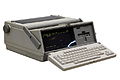
The Brother WP1, an electronic typewriter complete with a small screen and a floppy disk reader
Refuse [edit]
The stride of modify was so rapid that it was common for clerical staff to accept to learn several new systems, one after the other, in just a few years.[57] While such rapid change is commonplace today, and is taken for granted, this was not e'er so; in fact, typewriting engineering changed very piffling in its start 80 or 90 years.[58]
The increasing dominance of personal computers, desktop publishing, the introduction of low-cost, truly loftier-quality light amplification by stimulated emission of radiation and inkjet printer technologies, and the pervasive use of spider web publishing, electronic mail and other electronic advice techniques have largely replaced typewriters in the Us. Withal, as of 2009[update], typewriters connected to exist used by a number of government agencies and other institutions in the US, where they are primarily used to fill preprinted forms. According to a Boston typewriter repairman quoted past The Boston Earth, "Every maternity ward has a typewriter, as well as funeral homes".[59]
A rather specialized market for typewriters exists due to the regulations of many correctional systems in the Us, where prisoners are prohibited from having computers or telecommunications equipment, but are allowed to own typewriters. The Swintec corporation (headquartered in Moonachie, New Jersey), which, as of 2011, still produced typewriters at its overseas factories (in Japan, Indonesia, and/or Malaysia), manufactures a variety of typewriters for use in prisons, made of articulate plastic (to brand it harder for prisoners to hide prohibited items inside it). Every bit of 2011, the company had contracts with prisons in 43 Us states.[lx] [61]
In April 2011, Godrej and Boyce, a Mumbai-based manufacturer of mechanical typewriters, closed its doors, leading to a flurry of news reports that the "globe's last typewriter factory" had shut downward.[62] The reports were rapidly contested, with opinions settling to agree that it was indeed the globe's last producer of manual typewriters.[63] [64] [65] [66]
In November 2012, Blood brother's UK manufactory manufactured what it claimed to exist the last typewriter ever made in the United kingdom; the typewriter was donated to the London Science Museum.[67]
Russian typewriters use Cyrillic, which has made the ongoing Azeri reconversion from Cyrillic to Latin alphabet more difficult. In 1997, the regime of Turkey offered to donate western typewriters to the Azerbaijan in exchange for more zealous and exclusive promotion of the Latin alphabet for the Azeri language; this offering, however, was declined.[68]
In Latin America and Africa, mechanical typewriters are however common because they tin can be used without electric power. In Latin America, the typewriters used are well-nigh ofttimes Brazilian models; Brazil continues to produce mechanical (Facit) and electronic (Olivetti) typewriters to the present mean solar day.[69]
The early on 21st century saw revival of interest in typewriters among sure subcultures, including makers, steampunks, hipsters, and street poets.[70]
Correction technologies [edit]
According to the standards taught in secretarial schools in the mid-20th century, a business organisation letter of the alphabet was supposed to have no mistakes and no visible corrections.[71]
Correction fluid [edit]
A different fluid was available for correcting stencils. It sealed up the stencil ready for retyping only did non endeavor to color friction match.[72]
Legacy [edit]
Keyboard layouts [edit]
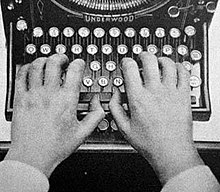
The "QWERTY" layout of typewriter keys became a de facto standard and continues to be used long after the reasons for its adoption (including reduction of key/lever entanglements) have ceased to employ.
QWERTY [edit]
The 1874 Sholes & Glidden typewriters established the "QWERTY" layout for the letter keys. During the period in which Sholes and his colleagues were experimenting with this invention, other keyboard arrangements were evidently tried, simply these are poorly documented.[73]
The QWERTY layout is not the well-nigh efficient layout possible for the English language. Touch-typists are required to move their fingers between rows to type the most common letters. Although the QWERTY keyboard was the most normally used layout in typewriters, a better, less strenuous keyboard was being searched for throughout the late 1900s.[74]
One popular but unverified[5] explanation for the QWERTY organization is that it was designed to reduce the likelihood of internal ambivalent of typebars by placing commonly used combinations of letters farther from each other within the machine.[75]
Other layouts [edit]
A number of radically different layouts such as Dvorak have been proposed to reduce the perceived inefficiencies of QWERTY, only none take been able to displace the QWERTY layout; their proponents claim considerable advantages, but so far none has been widely used. The Blickensderfer typewriter with its DHIATENSOR layout may have peradventure been the first attempt at optimizing the keyboard layout for efficiency advantages.[76]
On modern keyboards, the exclamation point is the shifted character on the i primal, because these were the last characters to get "standard" on keyboards. Property the spacebar down normally suspended the carriage advance machinery (a so-called "dead key" characteristic), allowing one to superimpose multiple keystrikes on a single location. The ¢ symbol (meaning cents) was located to a higher place the number six on American electric typewriters, whereas ANSI-INCITS-standard estimator keyboards take ^ instead.[77]
Typewriter conventions [edit]

A number of typographical conventions stem from the typewriter's characteristics and limitations. For instance, the QWERTY keyboard typewriter did not include keys for the en dash and the em nuance. To overcome this limitation, users typically typed more than one adjacent hyphen to approximate these symbols.[78] This typewriter convention is yet sometimes used today, even though modern calculator word processing applications tin input the correct en and em dashes for each font type.[79]
Other examples of typewriter practices that are sometimes all the same used in desktop publishing systems include inserting a double space between sentences,[eighty] [81] and the utilize of the typewriter apostrophe, ', and straight quotes, ", equally quotation marks and prime marks.[82] The do of underlining text in identify of italics and the employ of all capitals to provide emphasis are boosted examples of typographical conventions that derived from the limitations of the typewriter keyboard that still carry on today.[83]
Many older typewriters did not include a dissever key for the numeral one or the exclamation point !, and some even older ones likewise lacked the numeral null, 0. Typists who trained on these machines learned the habit of using the lowercase letter 50 ("ell") for the digit 1, and the upper-case letter O ("oh") for the zero. A cents symbol, ¢ was created by combining (over-striking) a lower case c with a slash character (typing c, so backspace, and so /). Similarly, the exclamation point was created past combining an apostrophe and a period ('+. ≈!).[84]
Terminology [edit]
[edit]

Humorous "Get out! Can't yous come across I'm busy" postcard (1900s)
When Remington started marketing typewriters, the company assumed the auto would not be used for composing but for transcribing dictation, and that the person typing would exist a adult female. The 1800s Sholes and Glidden typewriter had floral ornamentation on the example.[85]
During World Wars I and 2, increasing numbers of women were entering the workforce. In the U.s.a., women often started in the professional workplace as typists. Questions virtually morals made a salacious businessman making sexual advances to a female typist into a cliché of office life, actualization in vaudeville and movies. Being a typist was considered the right option for a "good girl", meaning women who present themselves as being celibate and having good comport.[86] According to the 1900 demography, 94.ix% of stenographers and typists were unmarried women.[87]
The "Tijuana bibles" – adult comic books produced in Mexico for the American market, starting in the 1930s – often featured women typists. In one console, a businessman in a three-piece suit, ogling his secretary's thigh, says, "Miss Higby, are you fix for—ahem!—er—dictation?"[42]
The typewriter was a useful car during the censorship era of the Soviet government, starting during the Russian Civil War (1917–1922). Samizdat was a form of self-publication used when the regime was censoring what literature the public could admission. The Soviet government signed a Decree on Press which prohibited the publishing of whatsoever written work that wasn't previously read over and approved.[88] This work was copied by hand, about often on typewriters.[89] At that place was a new constabulary in 1983 that required any possessor of a typewriter needed to become police permission to buy or keep, they would accept to annals a type sample of letters and numbers to ensure that any illegal literature typed with it could exist traced dorsum to its source.[ninety] The typewriter became increasingly popular every bit the interest in prohibited books grew.[91]
Writers with notable associations with typewriters [edit]
Early adopters [edit]
- Henry James dictated to a typist.[42]
- Mark Twain claimed in his autobiography that he was the first important author to nowadays a publisher with a typewritten manuscript, for The Adventures of Tom Sawyer (1876). Research showed that Twain'south retentivity was incorrect and that the commencement volume submitted in typed form was Life on the Mississippi (1883, also by Twain).[92]
Others [edit]

- William S. Burroughs wrote in some of his novels—and maybe believed—that "a automobile he called the 'Soft Typewriter' was writing our lives, and our books, into existence", according to a book review in The New Yorker. In the picture adaptation of his novel Naked Luncheon, his typewriter is a living, insect-like entity (voiced by Northward American histrion Peter Boretski) and really dictates the book to him.[93]
- J. R. R. Tolkien was likewise accustomed to typing from bad-mannered positions: "balancing his typewriter on his attic bed, because there was no room on his desk".[94]
- Jack Kerouac, a fast typist at 100 words per infinitesimal, typed On the Road on a roll of paper so he would not be interrupted by having to alter the paper. Inside ii weeks of starting to write On the Road, Kerouac had one unmarried-spaced paragraph, 120 feet long. Some scholars say the scroll was shelf paper; others contend it was a Thermal-fax curl; another theory is that the roll consisted of sheets of builder'south paper taped together.[42]
- Another fast typist of the Beat Generation was Richard Brautigan, who said that he thought out the plots of his books in detail beforehand, then typed them out at speeds approaching 90 to 100 words a minute.[95]
- Don Marquis purposely used the limitations of a typewriter (or more precisely, a particular typist) in his archy and mehitabel serial of newspaper columns, which were afterwards compiled into a serial of books. According to his literary conceit, a cockroach named "Archy" was a reincarnated gratuitous-poesy poet, who would type articles overnight past jumping onto the keys of a manual typewriter. The writings were typed completely in lower case, because of the cockroach'southward inability to generate the heavy strength needed to operate the shift central. The lone exception is the verse form "CAPITALS AT Concluding" from archys life of mehitabel, written in 1933.
- Author Ray Bradbury used a typewriter for rent at the library to write his work known as Fahrenheit 451, which was published in 1953.[96]
Late users [edit]
- Andy Rooney and William F. Buckley Jr. (1982) were among many writers who were very reluctant to switch from typewriters to computers.
- Richard Polt, a philosophy professor at Xavier University in Cincinnati who collects typewriters, edits ETCetera, a quarterly magazine about historic writing machines, and is the writer of the book The Typewriter Revolution: A Typist's Companion for the 21st Century.[97] [ full citation needed ]
- William Gibson used a Hermes 2000 model transmission typewriter to write Neuromancer and half of Count Zippo earlier a mechanical failure and lack of replacement parts forced him to upgrade to an Apple IIc reckoner.[98]
- Harlan Ellison used typewriters for his entire career, and when he was no longer able to have them repaired, learned to practice it himself; he repeatedly stated his belief that computers are bad for writing, maintaining that "Art is non supposed to be easier!"[99]
- Author Cormac McCarthy continues to write his novels on an Olivetti Lettera 32 typewriter to the present day. In 2009, the Lettera he obtained from a pawn shop in 1963, on which nearly all his novels and screenplays accept been written, was auctioned for charity at Christie's for U.s.a.$254,500;[100] McCarthy obtained an identical replacement for $20 to continue writing on.[101] [102]
- Will Self explains why he uses a transmission typewriter: "I think the computer user does their thinking on the screen, and the not-computer user is compelled, because he or she has to retype a whole text, to do a lot more thinking in the head."[103]
- Ted Kaczynski (the "Unabomber") infamously used ii former manual typewriters to write his polemic essays and messages.[102]
- Actor Tom Hanks uses and collects manual typewriters.[104] [102]
Typewriters in popular civilisation [edit]
In music [edit]
- Erik Satie's 1917 score for the ballet Parade includes a "Mach. à écrire" equally a percussion instrument, along with (elsewhere) a roulette wheel and a pistol.[105]
- The composer Leroy Anderson wrote The Typewriter (1950) for orchestra and typewriter, and it has since been used as the theme for numerous radio programs. The solo instrument is a real typewriter played by a percussionist. The piece was afterwards fabricated famous by comedian Jerry Lewis as part of his regular routine both on screen and stage, most notably in the 1963 motion-picture show Who's Minding the Store?.
- The Boston Typewriter Orchestra (BTO) has performed at numerous art festivals, clubs, and parties since 2004.[106] [107]
- South Korean improviser Ryu Hankil often performs typewriters, nearly prominently in his 2009 album Becoming Typewriter.[108]
Other [edit]
- The 2012 French comedy motion picture Populaire, starring Romain Duris and Déborah François, centers on a young secretary in the 1950s striving to win typewriting speed competitions.[109]
Forensic test [edit]
Typewritten documents may be examined past forensic document examiners. This is done primarily to make up one's mind one) the brand and/or model of the typewriter used to produce a certificate, or two) whether or not a particular suspect typewriter might accept been used to produce a document.[110]
The decision of a make and/or model of typewriter is a 'nomenclature' problem and several systems accept been developed for this purpose.[110] These include the original Haas Typewriter Atlases (Pica version)[111] and (Non-Pica version)[112] and the TYPE system developed by Dr. Philip Bouffard,[113] the Imperial Canadian Mounted Constabulary's Termatrex Typewriter nomenclature organization,[114] and Interpol's typewriter classification system,[115] among others.[110]
The earliest reference in fictional literature to the potential identification of a typewriter equally having produced a document was by Sir Arthur Conan Doyle, who wrote the Sherlock Holmes short story "A Instance of Identity" in 1891.[116] In non-fiction, the commencement document examiner[116] to depict how a typewriter might exist identified was William E. Hagan who wrote, in 1894, "All typewriter machines, fifty-fifty when using the aforementioned kind of type, go more or less peculiar past use every bit to the work done past them".[117] Other early discussions of the topic were provided by A. Due south. Osborn in his 1908 treatise, Typewriting equally Evidence,[118] and once again in his 1929 textbook, Questioned Documents.[119] A modern clarification of the test process is laid out in ASTM Standard E2494-08 (Standard Guide for Examination of Typewritten Items).[120]
Typewriter exam was used in the Leopold and Loeb and Alger Hiss cases. In the Eastern Bloc, typewriters (together with printing presses, copy machines, and later on figurer printers) were a controlled technology, with secret police in charge of maintaining files of the typewriters and their owners. In the Soviet Union, the First Department of each organization sent data on organization'south typewriters to the KGB. This posed a significant chance for dissidents and samizdat authors. In Romania, according to State Quango Prescript No. 98 of March 28, 1983, owning a typewriter, both past businesses or by private persons, was subject field to an approval given by the local police regime. People previously convicted of any crime or those who considering of their behaviour were considered to be "a danger to public order or to the security of the state" were refused approval. In addition, once a year, typewriter owners had to have the typewriter to the local police force station, where they would be asked to type a sample of all the typewriter's characters. Information technology was besides forbidden to infringe, lend, or repair typewriters other than at the places that had been authorized by the police.[121]
Collections [edit]
A number of public and individual collections of typewriters exist around the world:[122]
- Schreibmaschinenmuseum Peter Mitterhofer (Parcines, Italy)[123]
- Museo della Macchina da Scrivere (Milan, Italy)[124]
- Martin Howard Drove of Early Typewriters (Toronto, Canada)[125]
- Liverpool Typewriter Museum (Liverpool, England)
- Chestnut Ridge Typewriter Museum (Fairmont, West Virginia, The states)
- Technical Museum of the Empordà (Figueres, Girona, Kingdom of spain)
- Musée de la machine à écrire (Lausanne, Switzerland)[126]
- Lu Hanbin Typewriter Museum Shanghai (Shanghai, Mainland china)
- Wattens Typewriter Museum (Wattens, Republic of austria)
- German Typewriter Museum (Bayreuth, Germany)
- Tayfun Talipoğlu Typewriter Museum (Odunpazarı, Eskişehir, Turkey)
Several online-only virtual museums collect and display information about typewriters and their history:
- Virtual Typewriter Museum[127]
- Chuck & Rich's Antique Typewriter Website
- Mr. Martin's Typewriter Museum[128]
Gallery [edit]
-

Peter Mitterhofer 1864 typewriter
-

Hammond 1B typewriter, invented 1870s, manufactured 1881
-

Hammond 1B, as used past a newspaper office in Saskatoon around 1910
-

U.S. Regular army Quartermaster soldiers in typewriter repair shop, Tours, France, 1919
-

Typebars in a 1920s typewriter
-

-

1920s Underwood typewriter with Swedish layout
-

Chinese typewriter at Deutsches Technikmuseum
-
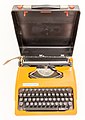
typewriter robotron S 1001 from VEB Robotron-Elektronik at the GDR, this sample is owned by the MEK
-
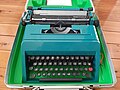
An Olivetti Studio 45 Typewriter
See as well [edit]
- Chorded keyboard
- Computer keyboard
- Duplicating machines
- Friden Flexowriter
- JOHNNIAC
- Letter (alphabet)
- Project keyboard
- Teletype Model 33
- Typeface
- Typescript
- Typewriter desk
- UNIVAC 1102
Notes [edit]
References [edit]
- ^ "typewriter (2)". Oxford English Dictionary. Vol. 18 (2d ed.). Oxford University Press. 1989. p. 789.
- ^ Cortada, James W. (2015). Before the Computer: IBM, NCR, Burroughs, and Remington Rand and the Industry They Created, 1865–1956. Princeton Academy Printing. p. 38. ISBN978-1-4008-7276-3. Archived from the original on 2018-06-26.
- ^ "Typewriters". www.officemuseum.com. Archived from the original on Dec 27, 2016.
- ^ "Typewriters, Writing a Social History of Urban India". The Wire. Retrieved 18 March 2019.
- ^ a b Stamp, Jimmy. "Fact of Fiction? The Legend of the QWERTY Keyboard". Smithsonian.
- ^ "The archives times – March – April 2013 – Lost and found, a 1984 photograph revives those times" (PDF). Godrej archives. Retrieved 18 March 2019.
- ^ Silver Reed"From backside the scenes – Godrej Prima and the Stenographers handbook" (PDF). world wide web.archives.godrej.com. Godrej archives. Retrieved xviii March 2019.
- ^ Acocella, Joan (April ix, 2007). "The Typing Life: How writers used to write". The New Yorker. Archived from the original on December 3, 2013.
- ^ "Scrittura". museocasertaolivetti.altervista.org (in Italian). Museo dinamico della tecnologia Adriano Olivetti. Archived from the original on 2017-06-21. Retrieved 2017-07-21 .
- ^ "Henry Manufacturing plant Patents". Todayinsci.com. Archived from the original on 2012-eleven-28. Retrieved 2012-03-30 .
- ^ "History of Computers and Calculating, Nascency of the modern computer, The bases of digital computers, typewriter and figurer keyboard". history-computer.com. Archived from the original on 2016-09-05. Retrieved 2016-09-xix .
- ^ "Italian Inventors and their Inventions". YourGuideToItaly.com. 2010. Retrieved 2011-01-25 .
- ^ Gianfrancesco Rambelli (1844). Intorno invenzioni east scoperte italiane (in Italian). Modena: Tipografia Vincenzi due east Rossi. p. 150.
- ^ William Austin Burt'southward Typographer. Scientific discipline Museum. 1829.
- ^ Utterback, James Thou. Utterback (1996). Mastering The Dynamics Of Innovation, second Ed. Harvard Business organisation Press. ISBN978-0-87584-740-5.
- ^ "Thurber'due south Chirographer – Scientific American". todayinsci.com. Archived from the original on 2015-03-27. Retrieved 2017-01-20 .
- ^ Adler, Michael (1997). Antique typewriters: from Creed to QWERTY. Atglen, Pa.: Schiffer Pub. ISBN978-0-7643-0132-2.
- ^ "Type Writing Motorcar". Scientific American. New. Vol. 17, no. 1. New York. 1867-07-06. p. 3. Retrieved 2009-01-14 .
- ^ "This is How Some of the World's Familiar Inventions Looked at the Time of Birth". Pop Mechanics. May 1929. p. 751.
- ^ "Fitch typewriter, 1891 | Science Museum Grouping Collection". collection.sciencemuseumgroup.org.great britain . Retrieved 2021-xi-23 .
- ^ "Gardner typewriter, c. 1893". collection.sciencemuseumgroup.org.u.k.. Scientific discipline Museum Group Collection. Retrieved 2021-eleven-23 .
- ^ "Underwood 1 Typewriter, 1897 | Science Museum Group Collection". collection.sciencemuseumgroup.org.u.k. . Retrieved 2021-11-22 .
- ^ Mares, G. C. (1909). The History of the Typewriter. London. p. 230.
- ^ "Early Office Museum". Archived from the original on 2 January 2014. Retrieved 1 December 2013.
- ^ Larson, Erik (2004). The Devil in the White Metropolis: A Saga of Magic and Murder at the Fair that Changed America. Knopf Doubleday Publishing Group. p. 291. ISBN978-ane-4000-7631-four. Archived from the original on 2018-06-26.
- ^ Hendrickson, Walter B. (1956). "The Three Lives of Frank H. Hall" (PDF). Journal of the Illinois Country Historical Club. University of Illinois Printing. 49 (3). Archived from the original (PDF) on 2010-08-06.
- ^ Anonymous (24 April 2011). "Hall Braille Writer". American Press House for the Blind, Inc. Archived from the original on 27 April 2012. Retrieved 29 February 2012.
- ^ Otto Burghagen (1898). Die Schreibmaschine. Illustrierte Beschreibung aller gangbaren Schreibmaschinen nebst gründlicher Anleitung zum Arbeiten auf sämtlichen Systemen.
- ^ Dieter Eberwein. Nietzsches Schreibkugel. Ein Blick auf Nietzsches Schreibmaschinenzeit durch die Restauration der Schreibkugel. Eberwein-Typoskriptverlag. Schauenburg 2005.
- ^ Johanne Agerskov (1925). Hvem er Skrivekuglens Opfinder? .
- ^ "Cartoon for a Typewriter". docsteach.org. Records of the Patent and Trademark Office, Record Group 241. June 23, 1868.
- ^ Jocher, Katharine; Bliven, Bruce (1954). "Reviewed piece of work: The Typewriter and the Men Who Made It., Richard N. Current; the Wonderful Writing Machine., Bruce Bliven, Jr". Social Forces. 33 (2): 197–198. doi:ten.2307/2573562. JSTOR 2573562.
- ^ a b "Start Practical Typewriter". Wisconsin Historical Club. March 22, 2007. Retrieved 25 April 2021.
- ^ a b Current, Richard N. (1949). "The Original Typewriter Enterprise 1867-1873". The Wisconsin Mag of History. 32 (iv): 391–407. JSTOR 4632060. Retrieved 25 April 2021.
- ^ a b c "Antique Index Typewriters". Early Office Museum. Archived from the original on 2 July 2016. Retrieved 13 March 2017.
- ^ a b Richard Polt. "The Classic Typewriter Page". "Simplex".
- ^ a b "The Mignon 2". The Virtual Typewriter Museum. Archived from the original on three October 2016. Retrieved 13 March 2017.
- ^ "The Remington Type-Writing Machine". Nature. xiv (342): 43–44. 1876. Bibcode:1876Natur..14...43.. doi:10.1038/014043a0.
- ^ Robert, Paul. "Daugherty". Collection. The Virtual Typewriter Museum. Archived from the original on July 29, 2011. Retrieved July 5, 2012.
- ^ Seaver, Alan (2011). "Daugherty Visible". Machines of Loving Grace website. Alan Seaver. Archived from the original on May 11, 2013. Retrieved July 5, 2012.
- ^ "How to prepare a mimeograph stencil by using a typewriter". LinguaLinks Library. SIL International. Archived from the original on 2012-10-16. Retrieved 2011-05-x .
- ^ a b c d Newyorker.com Archived 2007-09-29 at the Wayback Machine Acocella, Joan, "The Typing Life: How writers used to write", The New Yorker, Apr 9, 2007, a review of The Iron Whim: A Fragmented History of Typewriting (Cornell) 2007, by Darren Wershler-Henry
- ^ "Bert Kerschbaumer, "The Cahill Electrical Typewriters," ETCetera No. 100 (Dec 2012)" (PDF). Archived (PDF) from the original on 2016-07-30.
- ^ "P. Robert Aubert, "The Final Service Call," ETCetera No. 33(December 1995)" (PDF). Archived (PDF) from the original on 2016-07-30.
- ^ "U.S. Patent i,286,351 filed in May, 1910, and issued in December, 1918". Archived from the original on 2016-12-25. Retrieved 2011-09-xvi .
- ^ Colin Hempstead, William Due east. Worthington (2005). Encyclopedia of 20th Century Technology. Routledge. p. 605. ISBN978-one-57958-464-ane.
- ^ "IBM Electric Typewriter Model 01". 03.ibm.com. 23 January 2003. Archived from the original on 2013-05-26. Retrieved 2013-09-12 .
- ^ "Changing the Blazon of Typewriter Made Like shooting fish in a barrel". Pop Mechanics: 83. July 1931. Archived from the original on 2018-06-26.
- ^ "IBM Typewriter Milestones". IBM Athenaeum. 23 January 2003. Archived from the original on 2017-06-27.
- ^ a b IBM (7 March 2012). "The Selectric Typewriter". Icons of Progress . Retrieved 20 January 2020.
- ^ Ellen, David (2005). Scientific Exam of Documents. CRC Press. pp. 106–107. ISBN978-0-8493-3925-7.
- ^ Wershler-Henry, Darren (2005). The Fe Whim: A Fragmented History of Typewriting . Ithaca and London: Cornell Academy Press. p. 254. ISBN978-0-8014-4586-half dozen.
- ^ "The History of Smith Corona | Since 1877 to Present". Archived from the original on 2017-03-22. Retrieved 2017-03-12 .
- ^ Giuseppe Silmo (2007). Yard.P.S. Macchine per scrivere Olivetti e non solo. Fondazione Natale Capellaro. p. 74.
- ^ Usa patent 4620808, "Brandish typewriter", issued 1986-xi-04
- ^ "Smith-Corona". Mindmachine.co.uk. Archived from the original on 2013-05-28. Retrieved 2013-09-12 .
- ^ Davies, Margery Due west. (2004-01-fourteen). "WOMEN CLERICAL WORKERS AND THE TYPEWRITER: THE WRITING MACHINE". In Kramarae, Cheris (ed.). Engineering and Women's Voices. Routledge. doi:10.4324/9780203221938. ISBN978-0-203-22193-8.
- ^ AO (2020-01-29). "The Social club-Changing Invention of Typewriters". History Things . Retrieved 2021-05-18 .
- ^ Keene, Cindy Atoji (2009-02-01). "Typewriters ring on in the fringes". The Boston Globe. Archived from the original on 2013-08-26.
- ^ "The death of the typewriter? Don't write it off yet". Radio Netherlands Worldwide. 2011-04-27. Archived from the original on 2011-05-03. Retrieved 2012-03-30 .
- ^ "Texas inmates have clear choice in typewriters". Fixed-mobile-convergence.tmcnet.com. 2011-06-fifteen. Archived from the original on 2012-04-26. Retrieved 2012-03-xxx .
- ^ CBC News (April 26, 2011). "Earth's last typewriter plant stops production". Archived from the original on April 29, 2011. Retrieved April 27, 2011.
A previous version of this story did non clearly state that Godrej & Boyce appears to be the world's last maker of mechanical typewriters, which operate solely on man power. Numerous other manufacturers go along to make several types of electric typewriters.
- ^ "Wite Out? Globe'southward 'last typewriter factory' plainly isn't". Content.usatoday.com. 2011-04-26. Archived from the original on 2012-07-07. Retrieved 2012-03-xxx .
- ^ Romenesko, Jim (2011-04-26). "Reports of typewriter'southward death are premature". Poynter.org. Archived from the original on 2011-09-04. Retrieved 2012-03-30 .
- ^ Memmott, Marking (2011-04-26). "Has The Last Typewriter Factory Closed? Not Really". Npr.org. Archived from the original on 2012-03-13. Retrieved 2012-03-30 .
- ^ Rohrlich, Justin (2011-04-25). "Contrary to Reports, Typewriter Industry "Far From Dead"". Archived from the original on 2016-02-24.
- ^ "UK's 'last typewriter' produced". BBC. 2012-11-20. Archived from the original on 2013-12-xix. Retrieved 2013-09-12 .
- ^ Cornell, Svante (2005). Minor Nations and Great Powers: A Study of Ethnopolitical Conflict in the Caucasus. Taylor & Francis. p. 283. ISBN9781135796693.
- ^ "Ainda se fabricam máquinas de escrever? (Are typewriters notwithstanding manufactured?)". Mundoestranho.abril.com.br. Archived from the original on 2012-04-25. Retrieved 2012-03-30 .
- ^ Richard Polt, The Typewriter Revolution: A Typist's Companion for the 21st Century (Woodstock, VT: Countryman Press, 2015)
- ^ Lynn., Peril (2011). Pond in the steno pool : a retro guide to making information technology in the role. W.Due west. Norton & Co. p. 232. OCLC 1036875148.
- ^ "How to correct a mimeograph stencil". LinguaLinks Library. SIL International. Archived from the original on 2012-10-16. Retrieved 2011-05-10 .
- ^ Liebowitz, Southward. J.; Stephen E. Margolis (1990). "The Fable of the Keys". Periodical of Police force & Economic science. The University of Chicago. XXXIII (April 1990): 1. doi:10.1086/467198. S2CID 14262869. Archived from the original on 2008-07-03. Retrieved 2008-06-18 .
This article examines the history, economics, and ergonomics of the typewriter keyboard. We prove that David's version of the history of the marketplace'south rejection of Dvorak does not study the truthful history, and we present evidence that the connected apply of Qwerty is efficient given the electric current understanding of keyboard design.
- ^ Kroemer, Karl H.East (2014), "Keyboards and keying an annotated bibliography of the literature from 1878 to 1999", Universal Access in the Information Society, i (2): 99–160, doi:ten.1007/s102090100012, S2CID 207064170
- ^ David, P. A. (1986). "Understanding the Economics of QWERTY: the Necessity of History". In Parker, William N., Economic History and the Modern Economist. Basil Blackwell, New York and Oxford.
- ^ "Instructions for Using the Blickensderfer Typewriter". Archived from the original on 2014-02-21. Retrieved 2014-01-03 .
- ^ ANSI INCITS 154-1988 (R1999) Function Machines and Supplies - Alphanumeric Machines - Keyboard Arrangement (formerly ANSI X3.154-1988 (R1999)) (retrieved 2012-07-04)
- ^ Bringhurst, Robert (2004). The elements of typographic style (third ed.). Hartley & Marks, Publishers. p. lxxx. ISBN978-0-88179-206-v . Retrieved 10 November 2020.
In typescript, a double hyphen (--) is often used for a long nuance. Double hyphens in a typeset document are a sure sign that the blazon was fix past a typist, not a typographer. A typographer will utilize an em dash, three-quarter em, or en nuance, depending on context or personal style. The em dash is the nineteenth-century standard, all the same prescribed in many editorial fashion books, but the em dash is too long for use with the best text faces. Like the oversized infinite betwixt sentences, it belongs to the padded and corseted aesthetic of Victorian typography.
- ^ Upper and Lower Case Magazine. "U&lc Online Result 41.1.i: Height Ten Type Crimes". Retrieved 23 March 2010.
- ^ Williams, Robin (2003). The Mac is not a typewriter: A manner manual for creating professional-level type on your Macintosh (2nd ed.). Berkeley, California: Peachpit Press. ISBN978-0-201-78263-9.
- ^ Felici, James (2003). The Complete Manual of Typography: A Guide to Setting Perfect Blazon. Berkeley, California: Peachpit Press. p. fourscore. ISBN978-0-321-12730-three.
- ^ Rosendorf, Theodore (2009). The Typographic Desk Reference (1st ed.). New Castle, Delaware. ISBN978-one-58456-231-3. ; Upper and Lower Case Magazine. "U&lc Online Issue 41.1.ane: Top Ten Type Crimes". Retrieved 23 March 2010. ; Strizver, Ilene (2010). Type Rules: The Designer's Guide to Professional Typography (third ed.). New Jersey: John Wiley & Sons. p. 199. ISBN978-0-470-54251-4. . Strizver states that "When available, true primes should exist used for measurements, but typewriter quotes (not smart quotes) have get the accepted practice in digital typography."
- ^ Regents of the Academy of Minnesota (18 July 2007). "University of Minnesota Manner Transmission". University of Minnesota. Regents of the University of Minnesota. Archived from the original on January 17, 2009. Retrieved 12 May 2010. This topic is discussed nether "Creating Professional person-looking Text."; Williams 2003. pps. 31, 33. Some other example of the limitation of the typewriter in regard to underlining, was the necessity to underline the titles of books and stand-lonely works in Bibliographies—works that would otherwise accept been italicized, if that adequacy existed on the typewriter.
- ^ Truss, Lynn (2004). Eats, Shoot & Leaves: The Zero Tolerance Arroyo to Punctuation. New York: Gotham Books. p. 135. ISBN978-1-59240-087-4.
- ^ "1876 Sholes, Gidden, Soule invention". Archived from the original on 14 December 2012. Retrieved 29 December 2012.
- ^ Boyer, Kate, and Kim England. "Gender, Work and Technology in the Information Workplace: From Typewriters to ATMs." Social & Cultural Geography 9.3 (2008): 241–256. Web.
- ^ Waller, Robert A. "WOMEN AND THE TYPEWRITER DURING THE Kickoff FIFTY YEARS, 1873–1923". Studies in Popular Culture 9.1 (1986): 39–fifty. Web.
- ^ "Decree on the Printing". Seventeen Moments in Soviet History. 2015-08-25. Retrieved 2019-12-09 .
- ^ KULA: cognition cosmos, dissemination, and preservation studies. 2017. OCLC 1126556820.
- ^ Bolintineanu, Alexandra; Thirugnanasampanthan, Jaya (2018-11-29). "The Typewriter Under the Bed: Introducing Digital Humanities through Banned Books and Endangered Knowledge". KULA: Knowledge Cosmos, Dissemination, and Preservation Studies. 2 (1): 22. doi:10.5334/kula.30. ISSN 2398-4112.
- ^ Aleeva, Ekaterina (2017-07-10). "Samizdat: How did people in the Soviet Union circumvent state censorship". www.rbth.com . Retrieved 2019-12-09 .
- ^ "The Beginning Typewriter". Rehr, Darryl. Archived from the original on 2009-02-01. Retrieved 2009-02-16 .
- ^ Wershler-Henry, Darren Sean (2007). The Iron Whim: A Fragmented History of Typewriting. Cornell University Press. ISBN978-0-8014-4586-6.
- ^ Carpenter, Humphrey (1978). J. R. R. Tolkien: A Biography, Unwin Paperbacks p.207. ISBN 0 04 928039 2
- ^ Foster, Edward H., Richard Brautigan, Twayne 1983.
- ^ A Bruin Birthday Tribute To Ray Bradbury Tweet (August 22, 2010). "Offset Spark: Ray Bradbury Turns 90; The Universe and UCLA Academy Celebrate". Spotlight.ucla.edu. Archived from the original on October v, 2011. Retrieved September thirty, 2011.
- ^ Revolution, The Typewriter. "A Typist's Companion for the 21st Century". The Typewriter Revolution.
- ^ "Web log annal". Archived from the original on 2007-10-21. Retrieved 2008-10-23 .
- ^ "Harlan Ellison Webderland: Interview". Harlanellison.com. Archived from the original on 2012-03-08. Retrieved 2012-03-30 .
- ^ Kennedy, Randy (2009-12-04). "Cormac McCarthy's Typewriter Brings $254,500 at Auction – ArtsBeat Web log – NYTimes.com". Artsbeat.blogs.nytimes.com. Archived from the original on 2011-05-28. Retrieved 2010-01-xi .
- ^ Patricia Cohen (November 30, 2009). "No Country for Old Typewriters: A Well-Used 1 Heads to Auction". New York Times. Archived from the original on September iv, 2014.
- ^ a b c Joiner, James (11 September 2013). "The Hidden World of the Typewriter". The Atlantic . Retrieved 2022-01-23 .
- ^ "Why typewriters shell computers". BBC News. 2008-05-30. Archived from the original on 2017-08-04.
- ^ Hanks, Tom. "I Am TOM. I Like to Type. Hear That?". Retrieved March 9, 2020.
- ^ "IMSLP16532-Satie_-_Parade_(orch._score).pdf" (PDF). International Music Score Library Project.
- ^ Hurley, Sean. "Boston Orchestra Makes Typewriters Sing". NPR.org. National Public Radio. Archived from the original on 2012-03-08. Retrieved 2012-03-16 .
- ^ "The Boston Typewriter Orchestra". Wordpress. Archived from the original on 2012-04-04. Retrieved 2012-03-16 .
- ^ "Becoming Typewriter : Ryu Hankil : Gratis Download & Streaming : Internet Archive". 2001-03-10. Retrieved 2013-09-12 .
- ^ Dehn, Georgia (27 May 2013). "Déborah François interview for Populaire: 'Acting felt like a fantasy'". The Daily Telegraph. Archived from the original on 2022-01-eleven. Retrieved 1 June 2013.
- ^ a b c Kelly, Mary W. (2006). "Typewriters". Scientific Examination of Questioned Documents, Second Edition (Forensic and Police Science Series) (2nd ed.). Boca Raton, FL: CRC Press. pp. 177–189. ISBN978-0-8493-2044-half dozen.
- ^ Haas, Josef. (1972), "ATLAS der Schreibmaschinenschrift, PICA".
- ^ Haas, Josef and Bernhard Haas. (1985), "ATLAS der Schreibmaschinenschrift, Non-PICA".
- ^ Bouffard, P.D. (1992), A PC-Based Typewriter Typestyle Classification Arrangement Standard, presented at the American Academy of Forensic Sciences meeting, New Orleans, LA.
- ^ Hodgins, Cpl. J.H. (January 1963). "A Punchcard System for Identification of Typescript". Periodical of Forensic Sciences. 8 (1): 68–81.
- ^ Interpol (1969) "Arrangement for Identification of Typewriter Makes Using the Menu Alphabetize", ICPO-Interpol
- ^ a b Crown, David A. (March 1967). "Landmarks in Typewriting Identification". Journal of Criminal Law, Criminology, and Police Science. 58 (1): 105–111. doi:10.2307/1141378. JSTOR 1141378.
The earliest known reference to the identification potential of typewriting, curiously enough, appears in 'A Case of Identity', a Sherlock Holmes story by Sir Arthur Conan Doyle...
- ^ Hagan, William E. (1894). "Chapter Viii". Disputed Handwriting. Albany, NY: Banks & Brothers. p. 203.
- ^ Osborn, Albert S. (1908). "Typewriting as Evidence". Rochester, NY: The Genesee Printing: 23.
- ^ Osborn, Albert S. (1973) [1929]. "Questioned Typewriting". Questioned Documents (second ed.). Montclair, NJ: Patterson Smith. p. 1042. ISBN978-0-87585-207-2.
- ^ ASTM International Archived 2006-03-31 at the Wayback Car, These guides are under the jurisdiction of ASTM Committee E30 on Forensic Sciences and the direct responsibility of Subcommittee E30.02 on Questioned Documents. Copies of ASTM Standards tin exist obtained directly from ASTM International.
- ^ Betea, Lavinia (February thirteen, 2009). "La Miliţie cu maşina de scris" (in Romanian). jurnalul.ro. Archived from the original on September 4, 2015. Retrieved August 24, 2014.
- ^ Ways, Mark (October 28, 2021). "x Typewriter Museums You Should Visit". Typing Lounge . Retrieved 2022-01-23 .
- ^ "[Homepage]". Typewritermuseum . Retrieved 2022-01-23 .
- ^ "[Homepage]". Museo della macchina da scrivere (in Italian). Retrieved 2022-01-23 .
- ^ "Antique Typewriters - The Martin Howard Collection". Antique Typewriters . Retrieved 2022-01-23 .
- ^ "[Homepage]". Musée de la auto à écrire (in French). Perrier Machines de Bureau, Lausanne. Retrieved 2022-01-23 .
- ^ Robert, Paul. "The Virtual Typewriter Museum". Retrieved 2022-01-23 .
- ^ "Typewriter Museum". www.mrmartinweb.com . Retrieved 2022-01-23 .
Patents [edit]
- US79265 – Improvement in Type-Writing Machines (the patent that laid the basis for the Sholes & Glidden Type Writer)
- US349026 – typewriter ribbon, by George G. Anderson of Memphis, Tennessee.
Further reading [edit]
- Adler, M.H. (1973). The Writing Machine: A History of the Typewriter. Allen and Unwin.
- Beeching, Wilfred A. (1974). Century of the Typewriter. St. Martin's Press. pp. 276 Beeching was the Director of the British Typewriter Museum.
External links [edit]
 | Expect up typewriter in Wiktionary, the free lexicon. |
 | Wikimedia Commons has media related to Typewriter. |
- The Eclectisaurus online Museum of Typewriters past manufacturers from Adler to Voss.
- Almost Definitely My Type Video showcasing historical typewriters, with soundtrack by Boston Typewriter Orchestra
- Oliveira Typewriter (em português)
- Antique Typewriter Collecting, History & Resources for the Collector
- Early Typewriter Collectors' Association
- The Classic Typewriter Folio
- Typewriter: Free Minimal Text Editing Software the Behaves like a Typewriter
Revival [edit]
- Richard Polt, The Typewriter Revolution: A Typist'southward Companion for the 21st Century
- Ding, click clack -- typewriter is back—Quad-City Times, May 18, 2009
- Typewriters feel a improvement – UPI.com—United Printing International, December. 19, 2011
- Documentary Motion picture -- The Typewriter (In the 21st Century)—2012
- Kremlin returns to typewriters to avoid computer leaks—The Daily Telegraph, July 11, 2013
- Germany 'may revert to typewriters' to counter hi-tech espionage—The Guardian, July 15, 2014
0 Response to "Which Is the Center Key in an Old Fashioned Typewriter"
Post a Comment